
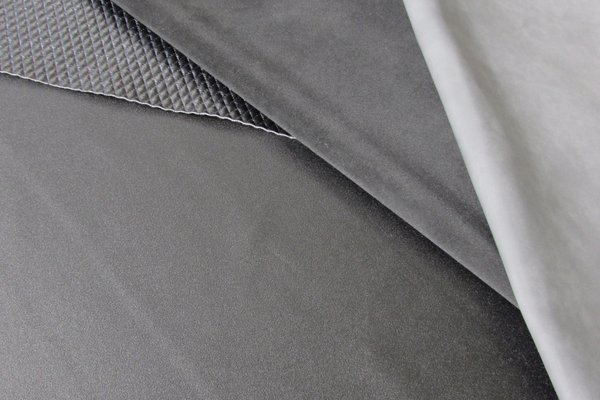
Our 100% polyurethane faux leather for car seat covers
Leather look, easy upkeep, friendly price: our 100% polyurethane faux leather is one of the most versatile materials for your car seat covers. Here's everything you need to know before choosing.
What exactly is faux leather?
Before getting into the detail, let's introduce it. Faux leather — also known as synthetic leather or "leatherette" — is a material designed to faithfully reproduce the look and feel of real leather, but using synthetic ingredients. And when it's done well, like ours, the resemblance is striking.
Concretely, our faux leather is made from 100% polyurethane (often called "PU leather"). This material was chosen for its suppleness, strength, long-term stability and visual finish very close to fine leather.
A story going back to 1920
A little history (we promise it's painless): faux leather isn't a new invention. The very first version, the famous Naugahyde, was born in the United States in 1920 in the laboratories of the United States Rubber Company. The idea, even then, was the same as today: offer an alternative to leather that's more accessible and easier to mass-produce.
Over a century later, the material has come a long way. Modern PU faux leathers have little in common with their ancestors: they're more breathable, suppler, more resistant and far more visually convincing. That's the kind of evolution you'll find in our material.
Why choose faux leather for your car?
Faux leather has plenty of arguments going for it, especially in cars. Its main strengths:
A look very close to leather. To the eye, few people can spot the difference. The grain, depth of colour, satin finish — it's all there. For an interior that looks the part without the price tag of real leather, it's hard to beat.
Maximum easy upkeep. A bit of neutral soap, a soft cloth, and you're done. No conditioner to apply several times a year, no special precautions. Faux leather is very forgiving.
Resistant to water and stains. Probably its biggest advantage over real leather. Liquids bead on the surface, and most stains lift off with a wipe of a sponge. Ideal if you regularly carry kids, pets, or eat in your car (no judgement here).
Stable over time. Faux leather doesn't expand, shrink or develop a patina the way real leather does. It keeps its original look — which, for many people, is a real plus.
Friendlier on the wallet. For the same visual finish, faux leather costs noticeably less than genuine leather. A serious argument, especially for full upholstery sets.
Our faux leather technical specs
For those who like figures and want to compare for real, here are the details:
Composition: 100% polyurethane (PU). No PVC, no blend — this is a high-end faux leather, more breathable and more durable than the PVC versions found in entry-level products.
Average thickness: 1.30 mm (+/- 2%). The ideal thickness for car upholstery: supple enough to follow the curves of your seats, sturdy enough to handle daily use.
Average weight: 750 g/m² (+/- 2%). A weight that reflects its density — and therefore its strength.
Resistance:
– Excellent resistance to friction and wear.
– Bend resistance: it adapts to curved areas without cracking.
– Positive results in tear resistance.
– Hydrolysis resistance: it doesn't suffer from moisture damage (sweat, spilled coffee, dripping umbrella…).
– Positive results in small-scale fire resistance tests, in line with automotive requirements.
In short: a real automotive faux leather, not a furniture-grade material rebranded for cars.
Real leather or faux leather: how to decide?
It's the question we hear most, and there's no wrong answer. It depends on what you're after.
If you want a more refined feel, a material that develops a beautiful patina, and you're planning to keep your car a long time while giving it a little attention, go for real leather.
If you want the leather look with fewer constraints, more resistance to everyday hassles and a friendlier budget, faux leather is unbeatable. It's also a great compromise for pros who drive a lot or for families with children.
If in doubt, the best thing is to feel the material. We're happy to send you a sample so you can make up your own mind. Nothing beats direct contact.
Which seats can you fit it on?
Our faux leather is used across our full custom upholstery range. You can install it on:
– Your front seats (the most-used spot, and where faux leather really shines).
– Your rear bench, especially well-suited if you regularly carry children or pets.
– Your headrests to match the rest.
– Your full upholstery set, for a consistent look from floor to ceiling.
– Your utility seats, where its resistance and easy upkeep are real assets for pros.
How to care for faux leather?
Caring for faux leather is one of its great strengths. A few simple rules:
Day-to-day: a damp sponge with a little neutral soap, with gentle circular movements. That's plenty for most spills.
For tougher stains: tackle them quickly — that's the best way to stop them setting in. A car interior cleaner does the job nicely.
What to avoid: solvents like acetone, bleach, abrasive products. They can damage the coating and make it dull or stiff. Apart from that, faux leather is very forgiving.
Bonus: unlike leather, no need to feed the material. Polyurethane doesn't need to be hydrated to stay supple.
Want to see what it looks like?
If you're still unsure, the best move is probably to order a sample, browse our range of upholstery materials, or check out our complete guide to car seat covers for a clearer idea.
Faux leather is the truly versatile material: easy to live with, elegant, accessible. Whether you just want to refresh the front seats or redo the whole upholstery, it's an excellent starting point. The choice is yours!


